



Establishing Clear Boundaries

Complicated systems fail under emotion; simple rules survive it. The most reliable stop-rule fits in one sentence: “When I reach my limit of time or money, I stop playing.” No exceptions clause, no “unless I’m close to winning it back,” no renegotiation window. The strength of a rule like this is precisely its bluntness — there is nothing to argue with at the moment when arguing is most tempting.
A few variants that work for the same reason:
- “I deposit once per session. When it is gone, the session is over.”
- “My alarm rings at sixty minutes. The ring means log out, not ‘five more minutes.'”
- “If I notice I am playing to recover a loss, I close the app immediately.”
- “I never play on days I feel angry, low, or bored — those sessions are never about entertainment.”
Pick one, write it down somewhere visible, and let it be boring. Boring rules are the ones that hold.
Time Management Tools
Money announces its departure; time slips out quietly. That asymmetry is why time tools matter as much as deposit limits, especially on a platform built around fast rounds and live action. Three tools cover most needs:
| Tool | How to use it | What it protects against |
| Timer or alarm | Set before the session, placed out of reach | Time blindness during play |
| Calendar reminder | Schedule sessions like appointments, with an end | Unplanned, drifting sessions |
| Session diary | Note start, end, and spend after each session | The illusion of “I barely play” |
The phone you play on can run all three. The discipline is not in the technology — it is in setting the tool before logging in, while judgement is still in charge, and obeying it afterwards, when judgement is tired.
Quick Break & Recovery
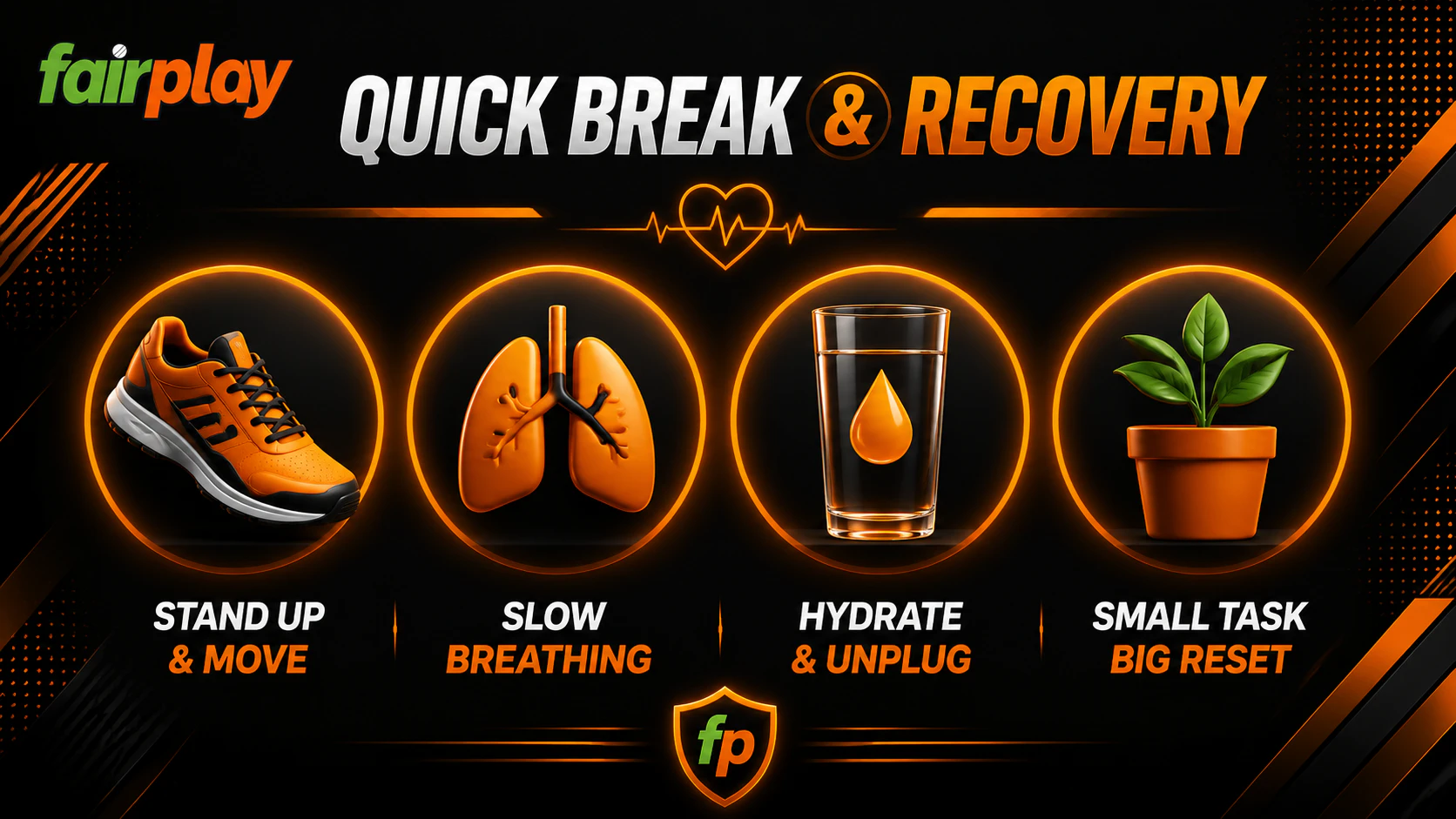
How a session ends matters almost as much as how long it ran. Closing the app and immediately opening another screen lets the session’s tension travel with you; a short recovery routine cuts the thread. Effective options take five minutes or less:
- Stand up and move — a short walk, stretches, anything physical
- Slow breathing: four counts in, hold, four counts out, repeated a few times
- A glass of water and a few minutes away from every screen
- A small task with a visible result — wash a cup, water a plant, tidy a desk
These sound trivial; their job is not to be impressive but to mark a clear boundary between play and the rest of the day. And when sessions start leaving residue that a five-minute routine cannot clear — lingering irritation, intrusive thoughts about the next session, guilt — that is the moment to talk to someone close, or to a professional. Reaching out early is maintenance, not crisis management.
Tracking Your Sessions
A session diary is the cheapest analytical tool in existence, and the most honest one. Memory edits; paper does not. After each session, record a handful of fields:
| Field | What to write | Why it matters |
| Date and duration | Start and end, actual not intended | Reveals time drift over weeks |
| Amount spent | The real figure, including re-deposits | Defeats mental rounding-down |
| Mood before | One word: calm, bored, stressed, low | Exposes emotional triggers |
| Mood after | One word again | Shows what sessions actually deliver |
| Notes | Anything unusual — chasing, limit broken | Catches patterns early |
Two weeks of honest entries answer questions that arguments with yourself never settle: which moods drive longer sessions, where the money actually goes, whether the stated limit and the lived limit are the same number. When the diary shows a gap between intention and behaviour, that is not a verdict — it is precise information about where the next limit needs to sit.
Recognizing Problem Gambling
Control rarely disappears in one day; it erodes, and the erosion has recognisable markers. Take these seriously, in yourself or in someone close:
- Debts, borrowed money, or essential funds flowing into play
- Sleep problems — sessions cutting into nights, or thoughts of play keeping you awake
- Irritability when playing is not possible, restlessness between sessions
- A persistent need to play more, longer, or with bigger stakes to feel the same interest
- Hiding sessions, spend, or losses from family and friends
- Work, study, or obligations losing ground to play
One marker is a signal to pause and re-examine the limits. Several together are a signal to stop and bring in help — a frank conversation with someone trusted, financial guardrails, the platform’s self-exclusion tools where offered, or a professional counsellor. Ignoring the signs does not make them milder; every one of them compounds quietly. The honest move, and the strong one, is acting while the choice is still fully yours.